
The main types of freight service in the Philippines are inland freight (trucking or road freight), RoRo shipping, air freight, sea freight, multimodal freight, and motorcycle courier services.
Each mode serves a different purpose depending on your cargo type, shipment size, delivery timeline, destination, and budget.
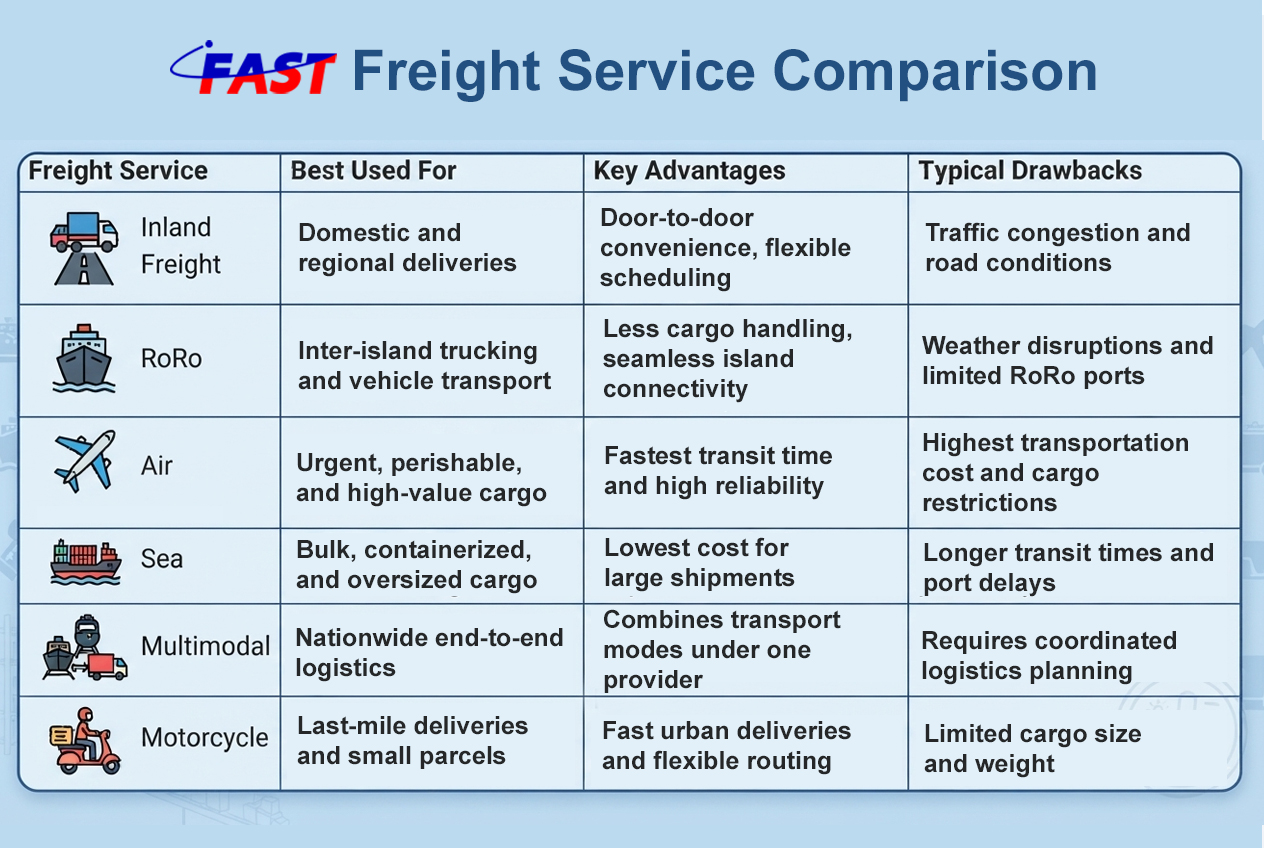
In the Philippines, freight services by logistics providers are generally categorized according to their mode of transportation and the volume of cargo being moved. Inland freight offers flexible short to medium-distance shipment, RoRo shipping enables inter-island cargo transfer, and air freight is ideal for urgent and high-value shipments. Likewise, sea freight provides the most economical option for large-volume cargo, while multimodal freight and motorcycle courier services address more complex or last-mile logistics requirements.
Understanding the strengths and limitations of each freight service helps businesses choose the most efficient and cost-effective solution for their supply chain operations. This guide compares the major freight services in the Philippines, their advantages, limitations, and ideal use cases.
Choosing the Right Freight Service for Your Shipment
What is a Freight Service in the Philippines
A freight service refers to the transportation of goods from one location to another through various modes of transport, including trucks, ships, aircraft, and motorcycles. Businesses use freight services to move products between manufacturing plants, warehouses, distribution centers, retailers, and end customers.
In the Philippines, freight services generally fall into six categories:
- Inland freight (Trucking or road freight)
- RoRo shipping
- Air freight
- Sea freight
- Multimodal or intermodal freight
- Motorcycle courier service
1. Inland Freight (Trucking or Road Freight)
Inland freight, also known as road freight or trucking, is the most widely used freight service in the Philippines. It transports goods over land, primarily by trucks, making it ideal for domestic and regional distribution.
One of its biggest advantages is its flexibility. Unlike other transport modes that require cargo to be transferred between ports or airports, trucking provides direct, door-to-door delivery.
Inland freight is ideal for retail replenishment, short- to medium-distance hub-to-hub deliveries, and mid-mile and last-mile transportation.
Advantages
- Door-to-door convenience
- Flexible delivery schedules
- Faster domestic transit
- Suitable for almost every industry
- Supports nationwide distribution
Limitations
- Traffic congestion may affect delivery schedules
- Long-distance transport can become more expensive than sea freight
- Weather and road conditions may cause delays
Types of Inland Freight
Full Truckload (FTL)
FTL is ideal when a shipment occupies an entire truck. Since cargo moves directly from origin to destination without consolidation, transit times are faster and cargo handling is minimized.
FTL is best suited for large-volume shipments, time-sensitive deliveries, and fragile or bulky cargo that requires dedicated truck space. Ten-wheeler and six-wheeler trucks are commonly used for FTL shipments.
Less-than-Truckload (LTL)
LTL allows multiple shippers to share truck space. Businesses only pay for the space they use, making it an economical option for smaller shipments.
Unlike FTL, LTL is ideal for small and medium-sized enterprises (SMEs) shipping smaller volumes, whether for regular replenishment or one-time deliveries.
2. RoRo Shipping
Roll-on/Roll-off (RoRo) shipping transports trucks, trailers, buses, and other wheeled cargo aboard specially designed vessels. Vehicles simply drive onto the vessel at the origin port and drive off upon arrival.
Given the Philippines’ archipelagic geography, RoRo plays a critical role in connecting Luzon, Visayas, and Mindanao while allowing cargo to remain inside the same truck throughout transit.
RoRo shipping is best for shipments that require inter-island transfers and nationwide distribution.
Advantages
- Less cargo handling reduces damage risk
- Faster transfer between islands
- Cost-effective compared to air freight
- Enables seamless truck-to-destination delivery
Limitations
- Weather can affect sailing schedules
- Limited to ports with RoRo facilities
- Generally more expensive than conventional containerized sea freight
3. Air Freight
Air freight is the fastest freight service in the Philippines, making it ideal for urgent shipments where delivery speed is the highest priority.
Although it is the most expensive transportation mode, businesses often rely on air freight for high-value, time-sensitive, or perishable products.
Air freight is commonly used by businesses in the electronics, pharmaceutical, healthcare, and food industries for transporting medical supplies, high-value goods, perishable products, and emergency shipments.
Advantages
- Fastest transit times
- High schedule reliability
- Reduced inventory carrying costs
- Strong cargo security
Limitations
- Highest transportation cost
- Weight and size restrictions
- Limited capacity for oversized cargo
4. Sea Freight
Sea freight is the preferred transportation mode for moving large volumes of cargo over long distances. It is significantly more economical than air freight and can accommodate oversized or heavy shipments.
Businesses shipping containerized cargo between major ports frequently choose sea freight for its cost efficiency.
Sea freight is best for bulk cargo, heavy equipment, vehicles that need to be transported, and other items that will be put in a sea container.
Advantages
- Lowest transportation cost per unit
- Handles large shipment volumes
- Suitable for oversized, heavy, or containerized cargo
- Reliable for planned replenishment
Limitations
- Longer transit times
- Port congestion may cause delays
- Weather and vessel schedules affect shipping
Types of Sea Freight
Full Container Load (FCL)
An FCL shipment uses an entire container exclusively for one customer. This option provides better cargo security and lower costs for high-volume shipments.
Less-than-Container Load (LCL)
LCL combines shipments from multiple customers into one container. Businesses only pay for the space they occupy, making it ideal for smaller cargo volumes.
5. Multimodal or Intermodal Freight
Multimodal freight combines two or more transportation modes under one integrated logistics solution.
For example, cargo may move by truck to a port, continue by RoRo or container vessel, and then be delivered by truck to its final destination.
Instead of coordinating multiple logistics providers, businesses work with a single logistics partner that manages the entire transportation process under one contract.
Multimodal freight is ideal for nationwide distribution, multi-island deliveries, and complex supply chains.
Advantages
- Simplified logistics management
- Greater supply chain visibility
- Reduced administrative work
- Optimized transit routes
- Better cost efficiency
Limitations
- Requires careful planning and coordination
- Dependent on multiple transport networks
6. Motorcycle Courier Service
Motorcycle courier services have become one of the fastest-growing freight services in the Philippines, particularly for urban deliveries.
Given traffic congestion in Metro Manila and other highly urbanized cities, motorcycles provide a faster way to transport small parcels, documents, medicines, food items, and e-commerce orders.
Many businesses outsource motorcycle deliveries to third-party logistics (3PL) providers instead of maintaining their own fleet.
Advantages
- Fast urban deliveries
- Lower delivery costs
- Flexible routing
- Ideal for traffic-heavy areas
Limitations
- Limited cargo capacity
- Not suitable for heavy or oversized shipments
- Weather may affect delivery operations
How to Choose the Right Freight Service in the Philippines
There is no one-size-fits-all freight solution. The best option depends on several factors:
- Delivery urgency
- Shipment size and weight
- Cargo value
- Budget
- Delivery destination
- Product type
- Supply chain requirements
Many businesses use a combination of freight modes to balance speed, cost, and operational efficiency. Working with an experienced 3PL provider like FAST Logistics Group can help determine the most effective transportation strategy for each shipment.
FAST Logistics Group: Trusted Transport and Freight Partner of Businesses
Selecting the right freight service in the Philippines means partnering with a logistics provider capable of supporting your entire supply chain. With over 50 years of industry leadership, FAST Logistics Group provides integrated end-to-end logistics solutions that combine:
- Inland freight (trucking or road freight)
- RoRo shipping
- Air freight
- Sea freight
- Warehousing
- Cold chain logistics
- Cross-docking
- Toll manufacturing or value-added services
Supported by one of the country’s largest logistics networks, FAST helps businesses move products in the Philippines more efficiently while improving visibility, reducing lead times, and optimizing transportation costs. Connect with our Solutions Experts today to learn which freight solution is best suited for your business
Categories
-
FAST Ahead
Includes case studies and testimonials of our partners as well as other featurettes from industry experts
-

FAST Hacks
We simplify logistics terms and provide practical tips and solutions for the DIY in you
-

FAST Highlights
Know more about our history, various brands, achievements, and news updates
-

FAST Moments
Get to know the people of FAST, our employee programs, as well as our various ways of giving back to the community
-
FAST Solutions
Learn more about the various logistics solutions that we cater to and offer our clients, as well as tech innovations, and service facilities
Related Stories

FAST Logistics, Chiongbian Group Choose JNEC To Power Key Operations with Renewable Energy
FAST Logistics Group and Chiongbian Group have partnered with Jin Navitas Electric Corp. (JNEC) as their electricity supplier to power several key facilities, strengthening their shift toward cleaner, most cost-efficient...
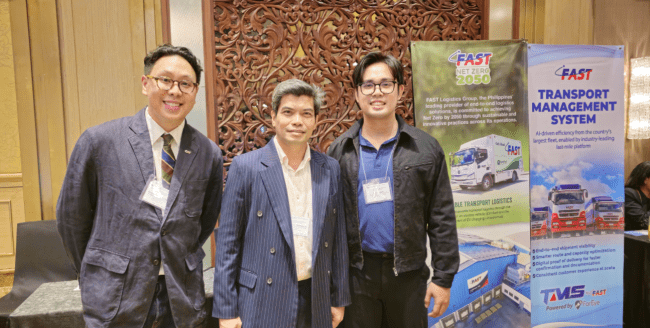
FAST Logistics Connects with US, Canada, Europe, Japan, and Korea Business Leaders at 21st Annual Joint Foreign Chambers Networking Night
FAST Logistics Group, the Philippines’ leading third-party logistics (3PL) provider, strengthened its engagement with the international business community during the 21st Annual Joint Foreign Chambers (JFC) Network...
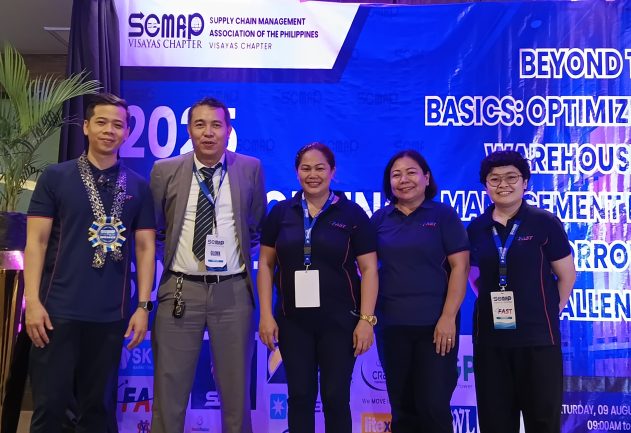
Leading the Way: FAST Showcases Warehouse Innovation at SCMAP Visayas Warehousing Summit
FAST Logistics Group, the country’s leading end-to-end logistics solutions provider, took center stage at the Warehousing Summit hosted by the SCMAP Visayas Chapter at Bai Hotel in Mandaue City, Cebu on Friday, August ...

FAST Logistics Group is the leading end-to-end logistics and supply chain solutions provider in the Philippines. With over 50 years of industry leadership, we offer a comprehensive suite of services including multi-modal transportation, warehousing, cross-docking, cold chain, and toll manufacturing solutions.
© Copyright 2026 FAST Logistics