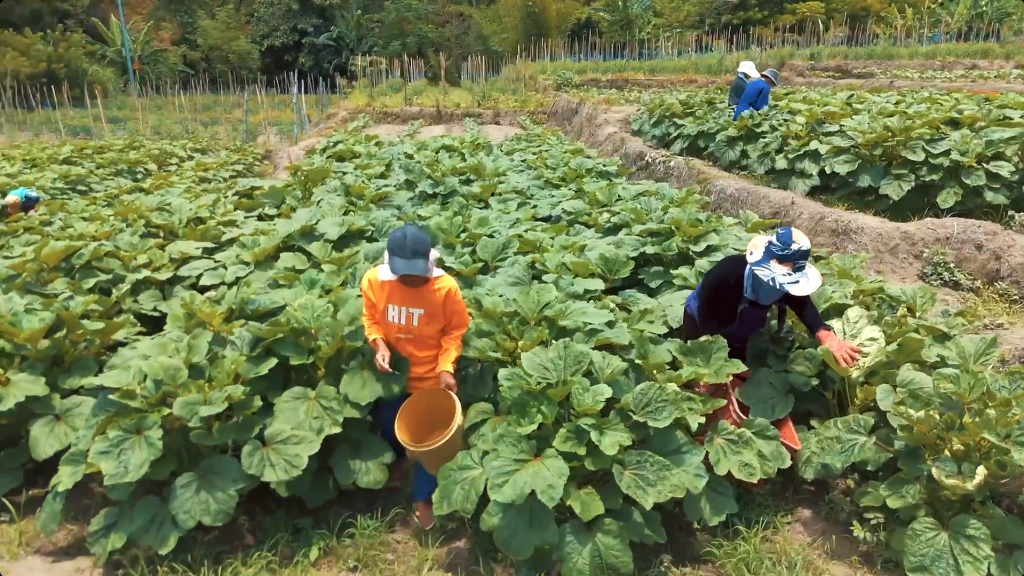
The Philippine food and agribusiness sector is entering a period of heightened uncertainty as global geopolitical tensions, climate-related disruptions, and agro-logistics and supply chain vulnerabilities reshape the operating environment.
These challenges and the strategies needed to address them were among the key discussions during the 2026 Mid-Year Food and Agribusiness E-Conference organized by the University of Asia and the Pacific – Center for Food and Agribusiness (UA&P-CFA) on Wednesday afternoon, July 8.
With the theme, “Philippine Food and Agribusiness amidst Global Disruptions: Risks, Resilience, and Opportunities,” the virtual conference brought together policymakers, economists, agribusiness leaders, and supply chain experts. They examined how the country can strengthen food security while building a more resilient agricultural economy.
Global Forces Shaping Philippine Agriculture
Presenting the Agriculture Scenarios in 2025-2026, UA&P-CFA Executive Director Marie Annette Dacul identified three global forces that are expected to shape Philippine agriculture over the coming years.
Geopolitical Tensions
First are geopolitical tensions, particularly developments in the Middle East, which have contributed to volatile energy markets and higher fuel costs.
Potential disruptions along key shipping routes such as the Strait of Hormuz, one of the world’s most critical oil transit corridors, increase transportation costs and disrupt supply chains.
Higher fuel costs eventually ripple through the food supply chain by increasing transportation, production, storage, and distribution expenses.
Trade Fragmentation
Second is trade fragmentation, where increasing protectionist policies and less predictable global trade flows are making supply chains more vulnerable to disruption.
For import-dependent countries like the Philippines, this increases exposure to disruptions while making sourcing and distribution more complex.
Climate Volatility
Extreme weather events remain one of agriculture’s largest uncertainties.
More frequent extreme weather events, prolonged droughts, and water scarcity continue to threaten agricultural production while making planning increasingly difficult for farmers and agribusinesses.
Dacul described climate-related shocks as “threat multipliers” that amplify existing vulnerabilities throughout the agricultural value chain.

Major Risks Continue to Threaten the Philippine Food Supply Chain
According to the UA&P-CFA, today’s agribusiness environment is defined by four interconnected risk pillars.
Environmental Risks
Environmental risks include El Niño, stronger typhoons, and emerging water scarcity, all of which threaten agricultural productivity.
Economic Risks
Economic risks stem from persistently high production costs, rising food inflation, and weaker consumer purchasing power.
Pathological Risks
Pathological risks remain significant as the industry continues to manage outbreaks of African Swine Fever, avian influenza, and crop pests.
Systemic Risks
Systemic risks such as import dependence and exposure to geopolitical disruptions affecting energy and shipping make food supply chains increasingly vulnerable to external shocks.
Agriculture Expected to Post Uneven Growth Across Subsectors
Agricultural performance is not expected to be uniform across all subsectors. Livestock and poultry are projected to outperform crops and fisheries over the next two years, according to UA&P-CFA estimates.
Agriculture Outlook for 2025-2026 Based on UA&P-CFA Estimates
The outlook suggests that while some industries may continue to expand, broader structural challenges remain unresolved.
| Industry | Growth Outlook |
| Crops | 3.0%–4.0% |
| Fisheries | 3.0%–4.0% |
| Livestock | 4.0%–5.0% |
| Poultry | 7.5%–8.5% |
The presentation also showed UA&P-CFA estimates a relatively flat outlook for the overall Agriculture, Forestry and Fisheries (AFF) sector in 2026, with projected growth ranging between -0.5% and 0.5% only.
Strategic Growth Opportunities for Philippine Agribusiness
Despite rising uncertainty, the UA&P-CFA identified six areas where businesses and policymakers can strengthen competitiveness and resilience.
Climate-Smart Agriculture
Deploying weather-resilient crop varieties alongside precision water management can help reduce climate-related production risks.
Digital Agriculture
Greater use of data analytics can improve yield optimization, farm decision-making, and supply chain visibility.
High-Value Agriculture
Shifting toward premium, higher-margin crops offers opportunities to improve profitability while reducing exposure to commodity price fluctuations.
Agribusiness Processing
Investing in value-added processing extends product shelf life while allowing producers to capture greater value further down the supply chain.
Logistics Modernization
Upgrading cold chain infrastructure and transportation networks can reduce post-harvest losses while improving food distribution efficiency.
Investments in cold chain facilities, transportation infrastructure, and modern distribution networks can significantly reduce losses, Dacul noted. She also said logistics modernization will help producers move products to market more efficiently.
Export Opportunities
Specialized Philippine agricultural products continue to present opportunities in niche global markets.
Agro-Logistics Modernization for Food Resiliency
While risks continue to grow, resource speakers and panelists highlighted practical strategies that can improve the competitiveness and resilience of Philippine agriculture.
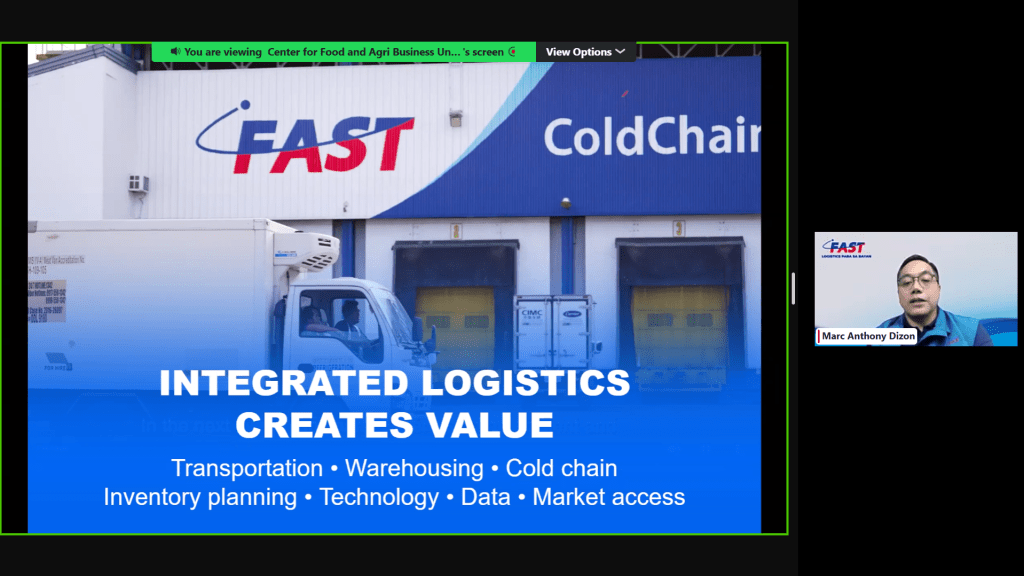
FAST Logistics Group Business Unit Head for Cold Chain Operations Marc Anthony Dizon underscored the importance of innovative and integrated logistics solutions in ensuring food safety, reducing losses, and strengthening food resiliency.
Citing FAST’s expertise and extensive experience in agro-logistics, particularly in serving leading food companies and agribusinesses, Marc said FAST has been instrumental in helping food producers expand their reach and distribute products nationwide.
This is supported by FAST’s integrated end-to-end logistics solutions spanning warehousing, multimodal transport, cold chain logistics, cross-docking, and value-added services. Its transport capabilities include inland freight, RoRo shipping, air freight, and sea freight.
FAST operates at a nationwide scale across Luzon, Visayas, and Mindanao, the country’s most extensive warehousing footprint, covering more than 160 dry and cold hubs and over 2 million square meters of warehouse space. It also operates the widest transport fleet in the Philippines with over 3,100 trucks of different types and sizes.
Complementing this infrastructure are investments in digital solutions that can help usher Philippine agro-logistics and food distribution into a smarter, more efficient era. FAST’s Warehouse Management System powered by Honeywell and Transport Management System by FarEye help automate operations, improve visibility, and optimize key steps across the value chain.
Cold Chain Infrastructure Needed Outside Metro Manila
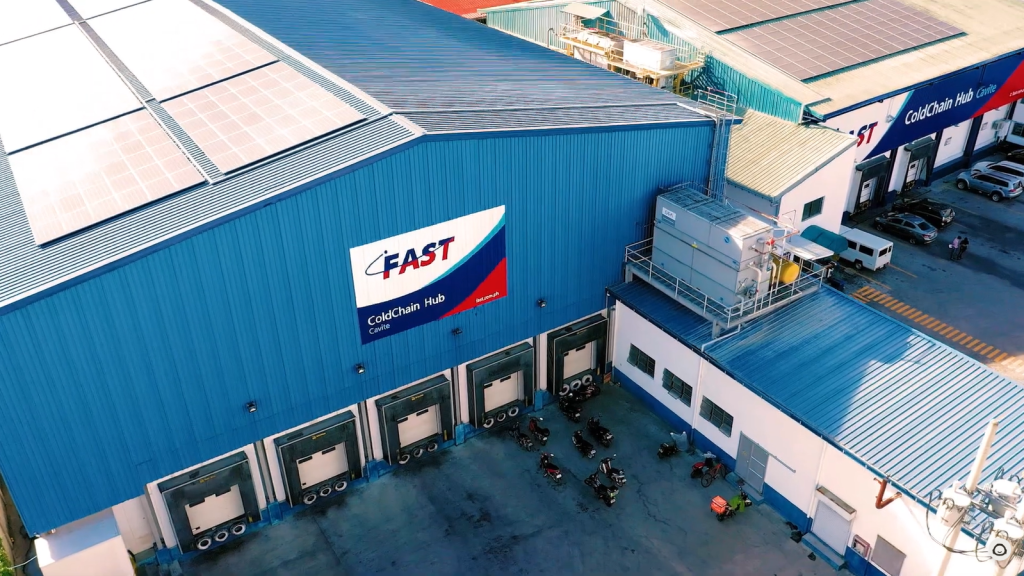
Marc said many of today’s food supply chain challenges cannot be addressed through production alone. He emphasized that cold storage infrastructure remains unevenly distributed across the country.
According to Marc, the Philippines requires approximately 1.4 million pallet positions based on annual food consumption requirements. However, the industry currently has only about 860,000 pallet positions, with much of the existing capacity concentrated around Metro Manila.
He noted that relatively few facilities are strategically located near agricultural production areas where products first need to be preserved.
“Cold storage facilities should be located closer to where agricultural products are produced—not only where they are ultimately consumed,” Marc said.
He also highlighted the need for a comprehensive agriculture database, supported by digital tools and analytics, to improve inventory planning, demand forecasting, and supply chain decision-making.

Shared Logistics to Manage Rising Agro-Logistics Costs
Geopolitical uncertainty has also increased transportation costs by driving fuel price volatility.
To address this, Marc said businesses are increasingly adopting shared logistics models, where companies consolidate cargo and use warehousing based on actual space consumed rather than maintaining dedicated transport and storage assets.
“Shared logistics enables companies to consolidate cargo and utilize warehousing based on actual consumption, helping businesses manage logistics costs more efficiently during periods of market volatility,” Marc said.
He added that shared logistics can help businesses optimize expenses by paying only for the warehouse and transport capacity they actually use, instead of shouldering the full cost of dedicated trucks and warehouse facilities.
Marc also emphasized the importance of ensuring that transport capacity remains available despite market disruptions.
Government Boosts Food Security Measures
Agriculture Assistant Secretary U-Nichols Manalo discussed ongoing reforms intended to strengthen the country’s rice industry.
Among these is the proposed Rice Bill. The proposed legislation seeks to institutionalize the Rice Industry Development Office, establish the National Rice Security Council, and restructure the National Food Authority.
The proposed legislation is anchored on four objectives:
- Food security and sovereignty
- Farmer protection
- Consumer access
- Industry resilience
He also shared that government agencies are preparing for a possible strong El Niño, citing PAGASA’s latest outlook indicating an 86% probability of the weather phenomenon.
The government’s response framework covers food, water, energy, health, and public safety. The government also prepares interventions such as cloud seeding.
Building a More Resilient Philippine Agro-Logistics and Food Supply Chain
Investments in climate-smart agriculture, digital technologies, cold chain logistics, and modern supply chain infrastructure were consistently identified as critical enablers of long-term resilience.
As geopolitical uncertainty, climate volatility, and shifting global trade patterns continue to reshape the food industry, resilient logistics networks will become increasingly essential to safeguarding food security and supporting the growth of Philippine agribusiness.
With over 50 years of experience supporting leading food manufacturers and other brands, FAST Logistics Group delivers integrated end-to-end logistics solutions to help businesses build resilient and agile supply chains. Connect with our Solutions Experts to learn how FAST can support your food and agribusiness operations nationwide
Categories
-

FAST Ahead
Includes case studies and testimonials of our partners as well as other featurettes from industry experts
-

FAST Hacks
We simplify logistics terms and provide practical tips and solutions for the DIY in you
-

FAST Highlights
Know more about our history, various brands, achievements, and news updates
-

FAST Moments
Get to know the people of FAST, our employee programs, as well as our various ways of giving back to the community
-

FAST Solutions
Learn more about the various logistics solutions that we cater to and offer our clients, as well as tech innovations, and service facilities
Related Stories
Operating in Mindanao? Here’s How to Expand Your Business to Manila and Cebu
Expanding your business beyond Mindanao can be challenging yet highly rewarding. For businesses based in Mindanao growth centers such as Davao City, Cagayan de Oro, Zamboanga, General Santos, Butuan, and Cotabato, expa...

Building Competencies – Key Questions to Ask When Designing Employee Training Program
FAST Logistics Group, the leading end-to-end logistics and selling distribution company in the Philippines, dives into the key questions managers should ask when designing an employee training program to support sustaina...

FAST Logistics, DTI Misamis Oriental Strengthen Partnership for End-to-End Trade Fair Support, Forward Stocking Solution for MSMEs
FAST Logistics Group and the Department of Trade and Industry (DTI) Misamis Oriental strengthened their partnership to empower micro, small, and medium enterprises (MSMEs) with stronger logistics support, end-to-end trad...

FAST Logistics Group is the leading end-to-end logistics and supply chain solutions provider in the Philippines. With over 50 years of industry leadership, we offer a comprehensive suite of services including multi-modal transportation, warehousing, cross-docking, cold chain, and toll manufacturing solutions.
© Copyright 2026 FAST Logistics