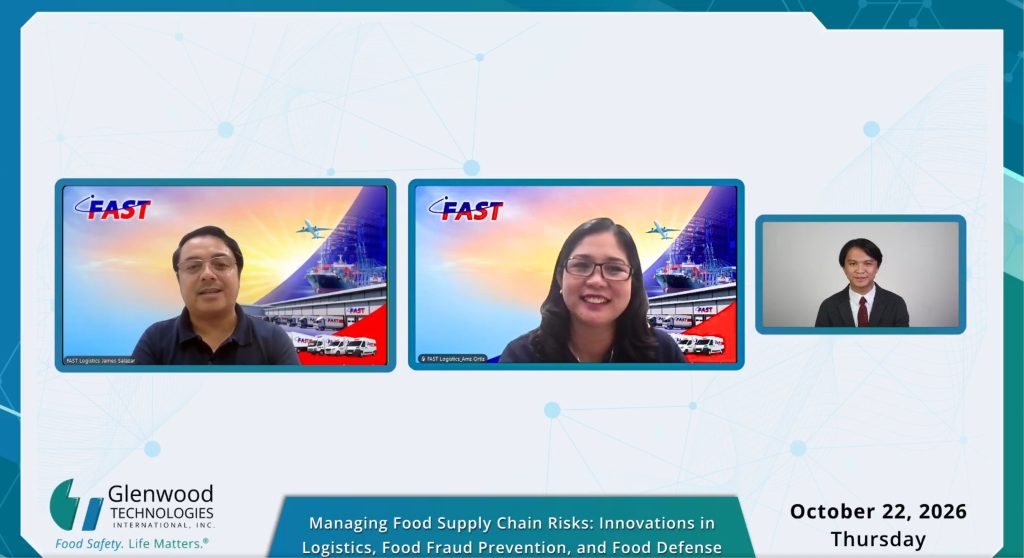
FAST Logistics Group, the Philippines’ leading provider of end-to-end logistics solutions, highlighted the importance of food safety controls, technology, and integrated logistics in building a safer and more resilient food and beverage (F&B) supply chain during a webinar organized by Food Safety Trends PH.
Speaking before supply chain professionals, logistics teams, and quality assurance (QA) experts, FAST Business Unit Head for Toll Manufacturing and Value-Added Services Robert James Salazar and Senior Manager for Commercial – Food and Beverage Segment and New Verticals Amz Ortiz shared practical insights on maintaining food safety, protecting product quality, and improving supply chain performance.
The webinar, which was also livestreamed on Food Safety Trends PH Facebook page on Thursday, October 23, underscored the importance of proper food handling throughout the supply chain to keep it safe and maintain its quality up to consumers.
FAST, an industry leader in Philippine logistics and supply chain, has been supporting multinational companies, Filipino conglomerates, and startups in the food and beverage sector across 3PL services, multi-modal transport (land freight or trucking, RoRo shipping, sea freight, and air freight), warehousing, cold chain, crossdocking, and value-added services or toll manufacturing.
QA Beyond Manufacturing: Process, Controls, and Technology for Food Safety and Compliance
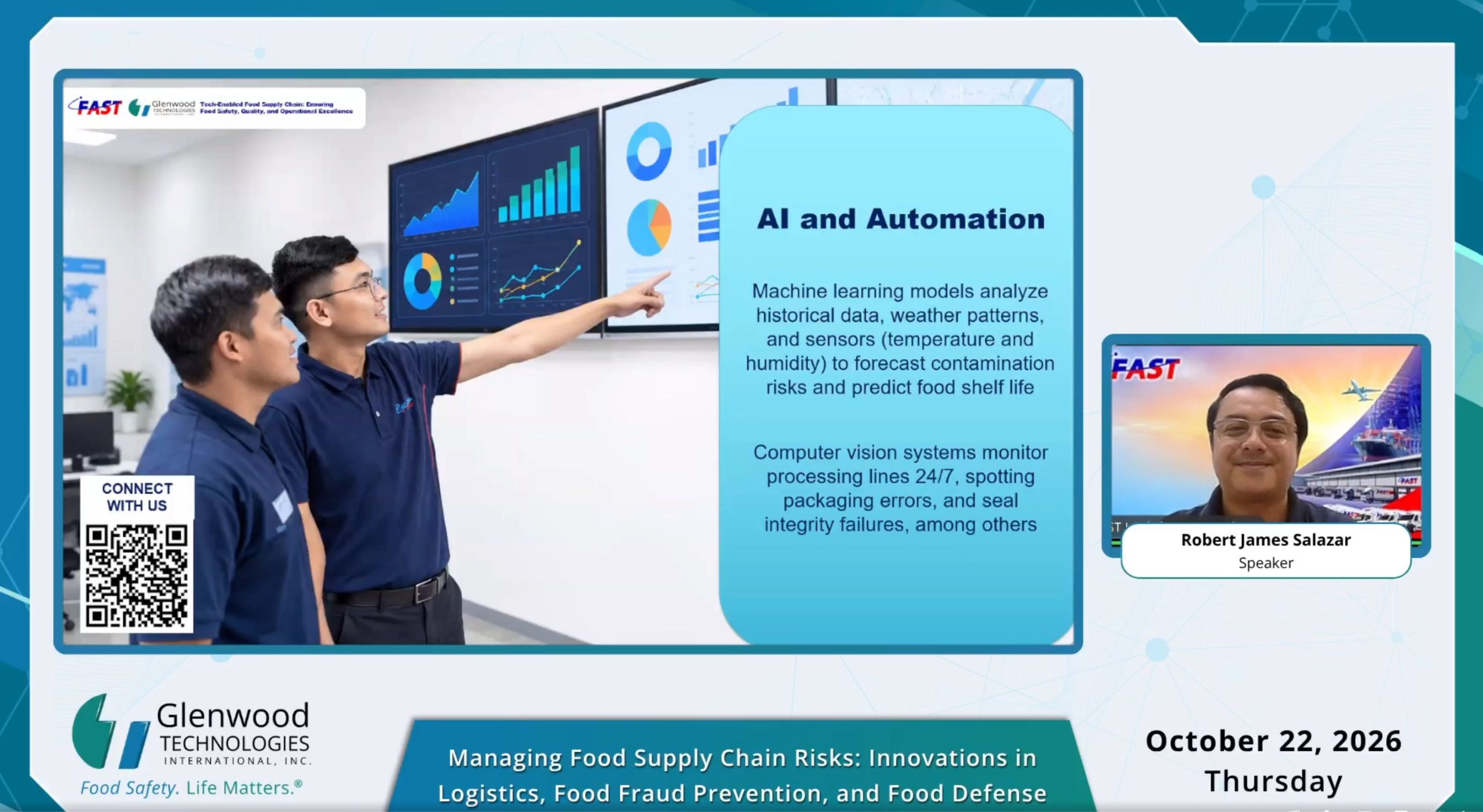
In his presentation, “Tech-Enabled Food Supply Chain: Ensuring Food Safety, Quality, and Operational Excellence,” James emphasized that food safety and operational excellence must be managed across the entire supply chain, not just within the manufacturing facilities, to ensure products reach buyers and consumers at its peak condition.
James also noted that every handoff presents potential risks, from supplier qualification and receiving inspections to warehouse storage, transportation, and product recalls, he said. Maintaining product integrity therefore requires consistent controls, appropriate handling procedures, and clear accountability across the entire supply chain.
He then said products must be received, stored, transported, and delivered under appropriate conditions.
“The role of QA professionals is evolving from inspection and testing to proactive risk management. QA professionals must work closely with operations and supply chain teams to prevent problems, monitor conditions, verify compliance, trace products, and drive continuous improvement,” he said.
James, who is also an expert in QA and food safety, highlighted the importance of established food safety frameworks and standards, including Good Manufacturing Practices (GMP), Hazard Analysis and Critical Control Points (HACCP), ISO standards, Food Safety System Certification (FSSC), Vulnerability Assessment and Critical Control Points (VACCP), and Threat Assessment and Critical Control Points (TACCP).
Compliance with the Food Safety Act of 2013 or Republic Act No. 10611, including applicable traceability requirements, further underscores the need to track food products through relevant stages of production, processing, and distribution.
But he stressed that their effectiveness depends on consistent implementation throughout the supply chain.
Organizations thus need to establish clear standards, monitor critical limits, document processes, and define responsibilities for addressing deviations. Businesses that embed these practices into daily operations can strengthen preventive controls and reduce risks to food safety and product quality.
Technology as Enabler of End-to-End Food Safety
In his presentation, James underscored the importance of technology in strengthening food safety controls by improving visibility, traceability, and operational efficiency.
James explained that Warehouse Management Systems (WMS) support inventory accuracy, product traceability, and First Expired, First Out (FEFO) practices.
In transportation, GPS tracking and control towers improve shipment visibility, while Transport Management Systems (TMS) support route planning, load optimization, and delivery tracking.
For products requiring temperature-controlled storage and transportation, intelligent cold chain solutions help maintain appropriate conditions throughout the journey.
Temperature and humidity monitoring, where applicable to product requirements, can help identify deviations that may compromise food safety and quality.
Meanwhile, AI and automation can support anomaly detection, risk identification, and predictive decision-making.
“However, technology must complement — not replace — sound processes, established standards, and trained personnel,” James said.
This integrated approach reinforces the importance of combining technology with operational discipline and technical expertise to maintain food safety and supply chain performance.
Beyond food safety controls, F&B businesses must navigate fluctuating demand, limited logistics capacity during peak seasons, rising operating costs, short product shelf life, and the complexities of nationwide distribution. These challenges require businesses to balance cost efficiency and product safety while meeting customer expectations.
End-to-End Food Safety and 3PL Solutions for Food and Beverage Companies
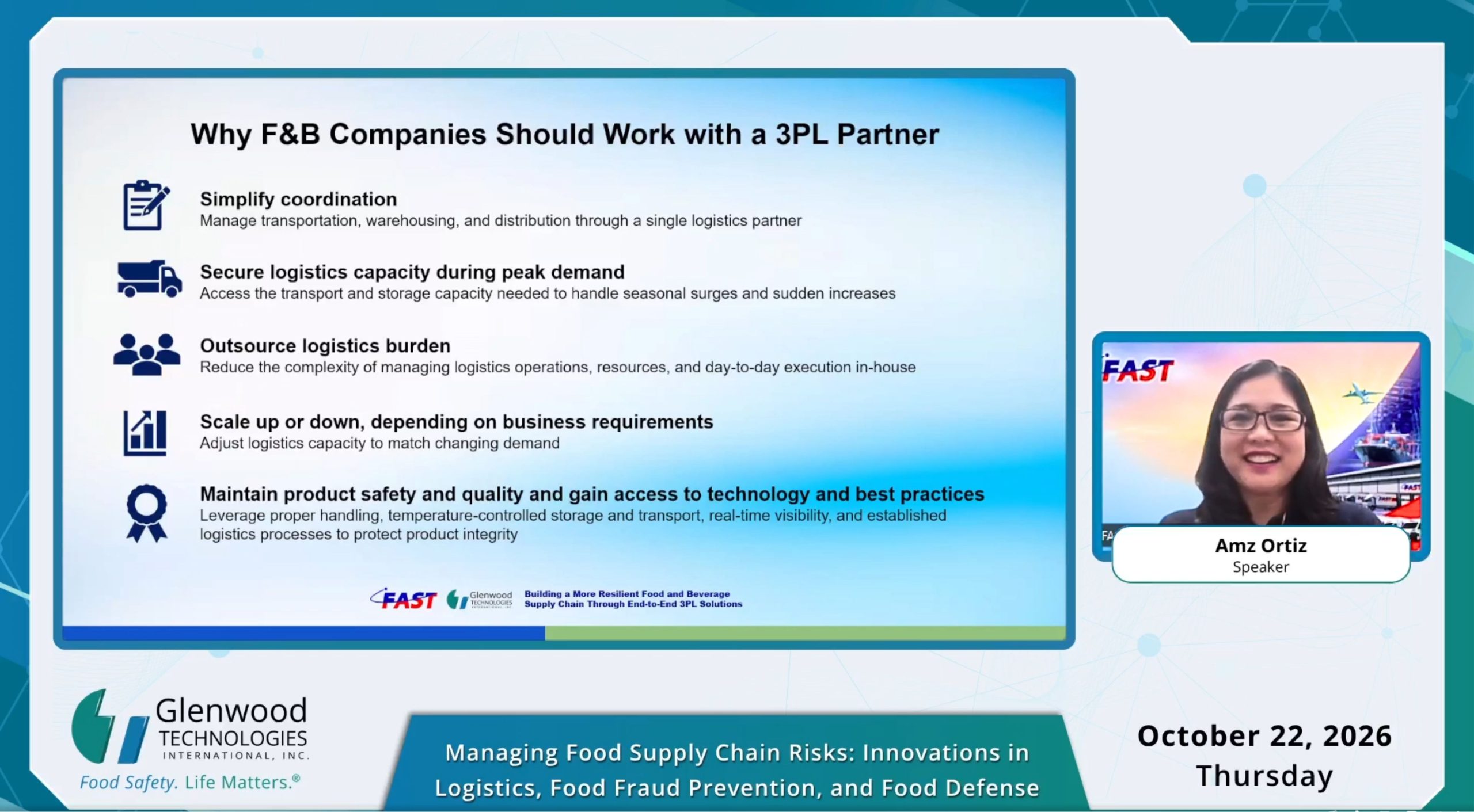
At the webinar, Amz highlighted how an integrated and reliable third-party logistics (3PL) partner can help businesses address these pressures by connecting multi-modal transportation (land, RoRo, air, and sea), warehousing, cold chain, cross-docking or direct-to-store deliveries, and value-added services or toll manufacturing into a coordinated supply chain.
By bringing these capabilities together, FAST helps businesses streamline their supply chain operations and adjust capacity as requirements change.
Rather than investing in and managing every logistics capability internally, companies can leverage FAST’s established network, infrastructure, technology, and expertise while focusing on their core operations.
“Outsourcing logistics allows businesses to access established capabilities, adjust capacity according to demand, and focus their resources on their core operations,” Amz said, underscoring FAST’s commitment to providing solutions tailored to the needs of its partners.
FAST’s approach is demonstrated through its work with food businesses facing different logistics challenges, Amz said.
Amz shared the example of a fruit and vegetable supplier that outsourced its transport operations to FAST, allowing the business to address fleet management requirements while supporting its expansion.
A nationwide bakeshop chain, meanwhile, relied on FAST’s integrated and intelligent cold chain solutions and demand planning support to help manage product transportation and logistics capacity.
FAST also supported a dairy startup by providing cold storage and transportation services, helping the business manage temperature-sensitive products and inter-island distribution requirements.
For a premium rice distributor expanding into new markets, FAST facilitated reliable inter-island deliveries and transportation to retail stores.
Through its integrated capabilities and customer-focused approach, FAST helps F&B businesses overcome logistics challenges, maintain product quality, and expand their market reach. Connect with our Solutions Experts to learn more
Categories
-
FAST Ahead
Includes case studies and testimonials of our partners as well as other featurettes from industry experts
-

FAST Hacks
We simplify logistics terms and provide practical tips and solutions for the DIY in you
-

FAST Highlights
Know more about our history, various brands, achievements, and news updates
-

FAST Moments
Get to know the people of FAST, our employee programs, as well as our various ways of giving back to the community
-
FAST Solutions
Learn more about the various logistics solutions that we cater to and offer our clients, as well as tech innovations, and service facilities
Related Stories

FAST to Hold One-Day Truckers Accreditation at Philippine Commercial Vehicle Show 2024 – Visayas
FAST Logistics Group, the leading end-to-end logistics company in the Philippines, is inviting truck owners and trucking companies to join its growing fleet. The logistics company will hold a one-day truckers accreditati...

Navigating the Retail Landscape: FAST Logistics Group Joins the 29th National Retail Conference and Expo
Attendees take interest in the various solutions put on view at the FAST booth during the 29th National Retail Conference and Expo FAST Logistics Group established a robust presence at the two-day exhibition of the 29th ...

FAST Logistics Showcases Integrated 3PL Capabilities at SCMAP Supply Chain Conference 2026
FAST Logistics Group, the Philippines’ leading provider of end-to-end logistics and supply chain solutions provider, showcased its integrated third-party logistics (3PL) capabilities and supply chain resilience strateg...

FAST Logistics Group is the leading end-to-end logistics and supply chain solutions provider in the Philippines. With over 50 years of industry leadership, we offer a comprehensive suite of services including multi-modal transportation, warehousing, cross-docking, cold chain, and toll manufacturing solutions.
© Copyright 2026 FAST Logistics